

What Is Parasite SEO?
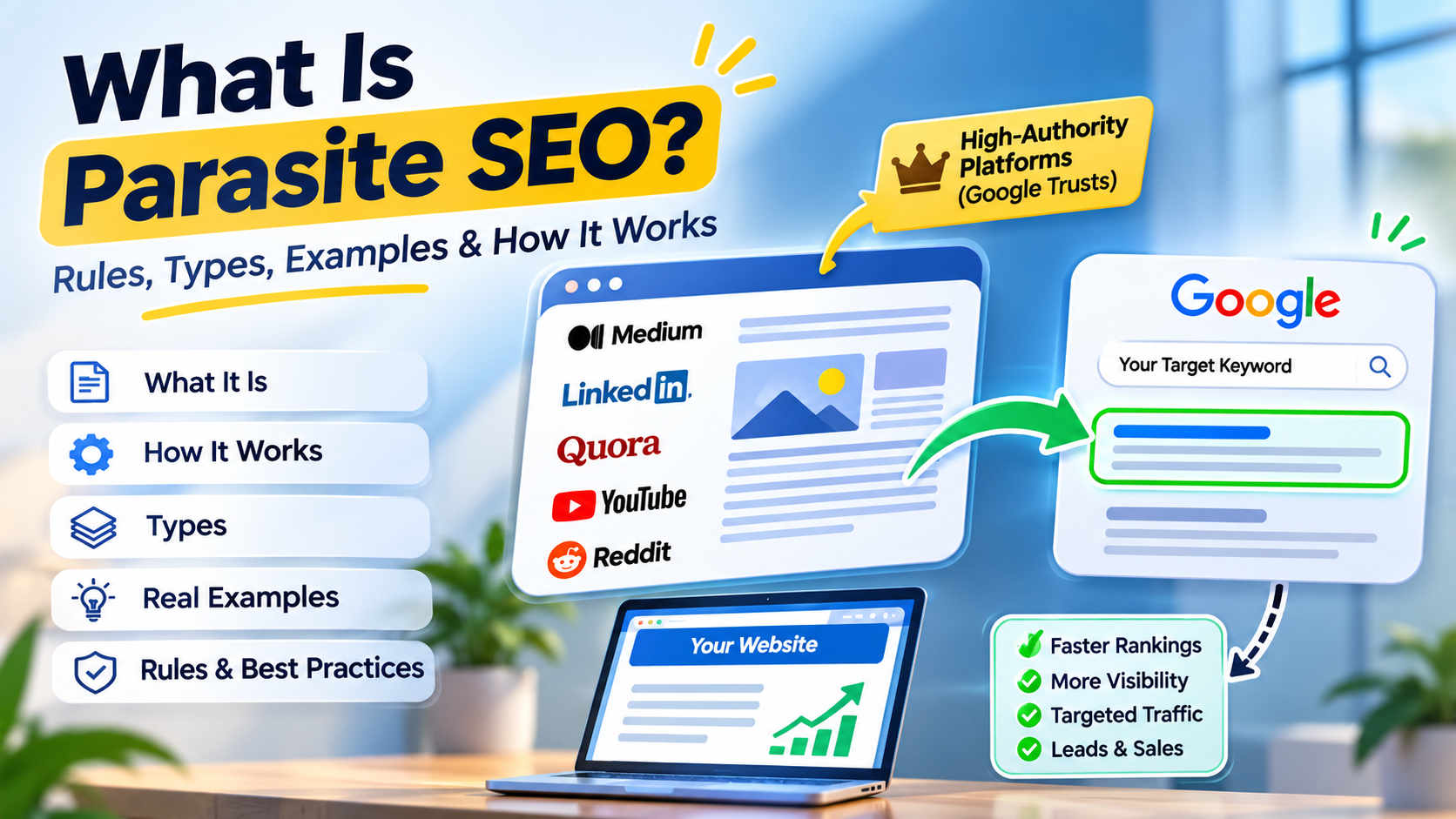
Search engine optimization (SEO) is constantly evolving, and businesses are always looking for effective ways to improve their visibility on Google. While traditional SEO focuses on optimizing your own website, there is another strategy that allows marketers to leverage the authority of already established websites to gain search engine visibility. This strategy is known as Parasite SEO.
Parasite SEO is an SEO technique in which marketers publish valuable, keyword-optimized content on high-authority third-party websites instead of relying entirely on their own domains. These platforms already have established online reputations, strong backlink profiles, and significant organic visibility, which may help individual pages gain search engine exposure.
For example, publishing an informative article on Medium, creating a LinkedIn article, answering relevant questions on Quora, or uploading an SEO-optimized YouTube video can help your content reach audiences beyond your own website.
The biggest advantage of this strategy is that you can potentially gain visibility for competitive keywords without waiting for your website to build authority over several months.
However, Parasite SEO is not a guaranteed shortcut to Google’s first page. Search engines evaluate individual content quality, relevance, usefulness, and other ranking signals. Additionally, publishing promotional or manipulative content on third-party platforms can create risks if their policies are violated.
In this comprehensive guide, we will explore what Parasite SEO is, how it works, its different types, practical examples, important rules, advantages, disadvantages, and how to implement it responsibly.
Parasite SEO: An Overview
Parasite SEO is a search engine optimization strategy that uses the existing authority and organic visibility of established websites to rank content in search engine results pages (SERPs).
Instead of publishing every piece of content exclusively on your own website, you strategically distribute useful content across relevant third-party platforms.
These platforms may already have:
- Strong domain-level authority and established backlink profiles.
- A large audience and regular website traffic.
- Well-indexed pages in Google search results.
- Established topical relevance in particular industries.
- Opportunities for publishing articles, videos, discussions, and answers.
In simple terms, you are using another website’s established online presence to increase the visibility of your own content.
In the Parasite SEO approach:
- You do not depend entirely on your own website for organic visibility.
- You publish content on established platforms such as Medium, LinkedIn, Quora, Reddit, and YouTube.
- You target relevant search queries where third-party content can provide genuine value.
- You use these platforms to increase brand awareness, attract potential customers, and generate referral traffic.
- You strategically direct interested visitors toward relevant pages on your website.
When Is Parasite SEO Commonly Used?
This strategy is often considered in situations such as:
- Highly competitive keywords: When a new website struggles to compete with established domains.
- Affiliate marketing: When marketers want to reach audiences searching for product comparisons, reviews, and recommendations.
- New businesses and startups: When a business has limited organic visibility on its own website.
- Market testing: When businesses want to evaluate keyword demand, audience interest, or a new product before investing heavily in a complete SEO campaign.
- Brand visibility: When businesses want their content to appear across multiple platforms in search results.
However, Parasite SEO should not be confused with guaranteed ranking manipulation. Publishing on a high-authority platform does not automatically transfer its authority to your individual article.
What Is Parasite SEO?
Parasite SEO is a technique where SEO-focused content is published on an established third-party website to benefit from its existing search visibility and authority.
The term “Parasite SEO” comes from the idea that your content uses the established online presence of another website to compete in search engine results.
For example, imagine you have recently launched a digital marketing website. Your website may not yet have enough authority to rank for a competitive keyword such as “Best Digital Marketing Agency in India.”
Instead of relying only on your own website, you could publish a detailed, informative article on Medium or LinkedIn that discusses the topic and provides genuine value to readers.
If the article satisfies search intent and performs well, it may appear in Google search results independently of your website.
Parasite SEO is also associated with terms such as:
- Barnacle SEO: A strategy of attaching your online presence to established websites that already rank for relevant searches.
- Piggyback SEO: Using the visibility of an established platform to reach a larger audience.
- Authority Leveraging: Taking advantage of the existing reputation and visibility of third-party websites.
Although these terms are sometimes used interchangeably, they are not always identical in their implementation.
Is Parasite SEO Black Hat, White Hat, or Grey Hat?
The classification depends on how the strategy is implemented.
- White Hat Approach: Publishing original, useful, relevant content that follows the platform’s publishing guidelines and provides genuine value to readers.
- Grey Hat Approach: Using aggressive keyword targeting, excessive promotional content, or questionable link-building practices that may not directly violate every policy but offer limited user value.
- Black Hat Approach: Exploiting established websites through spam, hacked pages, paid ranking manipulation, fake engagement, or other deceptive practices.
Google does not prohibit publishing content on third-party websites. However, manipulative practices intended to exploit another site’s ranking signals can violate Google’s spam policies.
The safest approach is to prioritize content quality, transparency, relevance, and compliance with platform guidelines.
Parasite SEO: Key Takeaways
Before exploring the complete process, here are some important points to understand:
- Parasite SEO uses the established visibility of third-party websites.
- It can help content gain search exposure without depending entirely on a new domain.
- Content quality and search intent remain essential ranking factors.
- Publishing on high-authority websites does not guarantee higher rankings.
- Different platforms serve different audiences and content formats.
- Spammy backlinks and manipulative publishing practices can create SEO risks.
- It should complement your long-term website SEO strategy rather than replace it.
When Should You Use Parasite SEO?
Parasite SEO can be useful in specific marketing situations, particularly when gaining additional search visibility is important.
Let’s understand the most common scenarios.
1. Highly Competitive Niches
Some industries are extremely competitive in organic search results. Finance, digital marketing, technology, real estate, insurance, and online education are examples of industries where established websites often dominate important keywords.
A newly launched website may find it difficult to compete against these established domains.
In such situations, publishing a well-researched article on a relevant third-party platform can provide another opportunity to reach the target audience.
However, the platform’s domain authority alone does not guarantee that your content will rank.
2. When Faster Online Visibility Is a Priority
Traditional SEO requires consistent efforts involving technical optimization, content development, internal linking, and backlink acquisition.
Parasite SEO offers an additional publishing channel where you can potentially reach an existing audience and gain search visibility sooner.
For example, a business launching a new service could publish educational articles on LinkedIn and Medium to attract relevant readers.
This can support brand discovery while the company’s own website continues building organic authority.
3. Businesses With Limited Marketing Budgets
Startups and small businesses may not have sufficient resources to invest in extensive SEO campaigns immediately.
Publishing on platforms that offer free content distribution can be a cost-effective way to build initial brand awareness.
However, free publishing does not mean zero investment. Research, content writing, editing, optimization, and promotion still require time and resources.
4. Keyword and Market Testing
Parasite SEO can also support keyword and market research.
Suppose you are planning to launch a new product or service but are unsure whether people are interested in it.
You can publish relevant informational content on platforms such as Medium, LinkedIn, or Reddit and observe audience engagement.
Monitor:
- Which topics attract the most readers.
- Which keywords generate impressions.
- Which questions receive meaningful engagement.
- Which content formats generate clicks.
- Which topics attract potential customers.
These insights can help you decide which subjects deserve dedicated content on your main website.
5. Building Brand Awareness and Online Reputation
Your potential customers may discover your business through several different platforms before visiting your website.
Publishing informative content across relevant channels increases your brand’s digital presence and provides additional opportunities to demonstrate expertise.
For example, a digital marketing agency can publish SEO guides on Medium, share industry insights on LinkedIn, answer marketing questions on Quora, and create educational videos on YouTube.
This creates multiple touchpoints between your brand and potential customers.
How Does Parasite SEO Work?
Parasite SEO works by publishing content on an established third-party website that already has organic search visibility.
Search engines discover and evaluate the published page based on multiple factors, including its relevance, quality, originality, usefulness, and the overall context of the search query.
The third-party website may have an established backlink profile and a history of ranking in Google. However, its authority does not automatically pass to every newly published page.
Step-by-Step Working Process
Step 1: Identify a Competitive Keyword
Start by researching keywords relevant to your business, product, or industry.
For example:
- Best SEO Agency in India
- Digital Marketing Services for Small Businesses
- How to Improve Google Business Profile Rankings
- Best Modular Kitchen Materials
- Local SEO Strategies for Businesses
Use keyword research tools to understand search volume, keyword difficulty, competition, and search intent.
Step 2: Find a Relevant High-Authority Platform
Identify established websites that allow content publishing and have audiences relevant to your topic.
Examples include Medium, LinkedIn, Quora, Reddit, and YouTube.
Do not select a platform only because it has a high Domain Authority (DA). Check its topical relevance, audience quality, editorial standards, and publishing policies.
Step 3: Create Valuable and Optimized Content
Prepare original content that answers the user’s search query.
Your article should have:
- A clear and keyword-relevant title.
- A useful introduction.
- Properly structured H2 and H3 headings.
- Relevant examples and practical explanations.
- Naturally placed keywords and related terms.
- Relevant images or supporting media.
- Useful internal platform links or external references where appropriate.
Step 4: Publish the Content
Publish your article on the selected platform according to its guidelines.
For example, you could publish a detailed SEO guide on Medium or a professional industry article on LinkedIn.
Make sure the content is suitable for the platform’s audience rather than simply copying promotional website content.
Step 5: Add Relevant Website Links
Where platform policies allow, include contextual links to relevant resources on your website.
For example, if your article explains local SEO, you can link to your detailed guide on Google Business Profile optimization, such as our post on tips to improve your local ranking on Google Maps.
Use descriptive anchor text that accurately explains the destination page.
Avoid excessive links, irrelevant commercial anchors, and repetitive promotional references.
Step 6: Promote and Distribute Your Content
After publishing, share the content through relevant social media channels, professional communities, and newsletters where permitted.
Genuine engagement can help your content reach a wider audience.
Step 7: Track and Analyze Performance
Monitor the published content using Google Search Console where available, platform analytics, referral traffic reports, and keyword tracking tools.
Important metrics include:
- Organic impressions.
- Organic clicks.
- Keyword positions.
- Referral traffic.
- Engagement and reading time.
- Website conversions and qualified leads.
This information helps you identify which platforms and topics are producing meaningful results.
How to Do Parasite SEO (Step-by-Step Guide)
Now that we understand how Parasite SEO works, let’s explore a practical implementation strategy.
1. Identify High-Authority Websites
The first step is finding suitable third-party publishing platforms.
Look for websites with:
- Established organic search visibility.
- Relevant audiences.
- Strong topical relevance.
- Genuine user engagement.
- Content publishing opportunities.
- Clear editorial and linking guidelines.
Some popular platforms include:
| Platform | Best Use Case |
|---|---|
| Medium | Informational articles and long-form blogs |
| Professional content and B2B marketing | |
| Community discussions and niche topics | |
| Quora | Question-based content and educational answers |
| YouTube | Video SEO and visual content |
| Blogger | Blog publishing and content distribution |
Remember that platform selection should depend on your target audience and content type, not just domain-level metrics.
2. Perform Keyword Research
Keyword research is one of the most important parts of an effective Parasite SEO campaign.
Before creating content, identify the exact queries your target audience uses.
Focus on:
- Primary keywords.
- Secondary keywords.
- Long-tail keywords.
- Question-based keywords.
- Commercial investigation keywords.
- Informational search queries.
For example, if you are promoting digital marketing services, your keyword list might include:
Primary Keyword: Digital Marketing Agency in India
Secondary Keywords:
- Best Digital Marketing Company.
- SEO Services for Small Businesses.
- Google Ads Management Services.
- Local SEO Agency.
- Social Media Marketing Services.
Choose keywords that match the publishing platform and the audience’s expectations.
3. Create High-Quality Content
Content quality determines whether readers find your article useful.
Avoid publishing thin articles that exist only to insert keywords and backlinks. The same problem hurts websites too, as we explain in why area pages stop ranking.
Instead, focus on creating original, comprehensive, and informative content.
Follow these content guidelines:
- Answer the main search query directly.
- Include relevant examples and practical insights.
- Use clear language and logical paragraph structure.
- Add supporting statistics only when they can be verified.
- Include relevant headings and subheadings.
- Avoid unnecessary keyword repetition.
- Make the content useful even if readers never visit your website. Google’s guidance on creating helpful, people-first content is a good benchmark.
The objective should be to satisfy the reader’s needs rather than simply manipulate search rankings.
4. Optimize Content for SEO
Even when publishing on an established platform, basic SEO optimization remains important.
Consider the following elements:
SEO Title: Create a clear and relevant title that communicates the article’s topic.
Headings: Organize information using H1, H2, and H3 headings where the platform supports them.
Keyword Placement: Include the primary keyword naturally in the title, introduction, and relevant sections.
Content Structure: Use short paragraphs, bullet points, tables, and examples to improve readability.
Images: Add relevant, original images and descriptive alternative text wherever supported.
Descriptive URLs: Use clean and readable URLs if the publishing platform allows customization.
Search Intent: Ensure the article provides the information users are actually looking for.
5. Add Backlinks Strategically
Backlinks can help users discover related resources and visit your website.
However, not every backlink improves SEO performance.
When adding links:
- Link only to relevant and useful website pages.
- Use natural anchor text.
- Avoid adding multiple links unnecessarily.
- Do not purchase or exchange links to manipulate rankings.
- Follow the platform’s external linking policies.
- Disclose sponsored relationships where required.
It is also important to understand that links from third-party platforms may be marked as nofollow or sponsored. Such links can still generate referral traffic and brand exposure, but should not be assumed to transfer ranking authority. Google explains these link attributes in its guide to qualifying outbound links.
6. Promote and Monitor Published Content
Publishing an article is only one part of the process.
You should also distribute it through appropriate channels and monitor how users interact with it.
Track:
- Search impressions and clicks.
- Keyword ranking changes.
- Referral traffic.
- Social engagement.
- Website enquiries.
- Leads and conversions.
Use the collected data to improve future content and focus on the platforms that deliver meaningful results.
Types of Parasite SEO
Parasite SEO can be implemented through several types of third-party platforms.
Each platform offers different publishing opportunities and audience engagement methods.
1. Social Media Platforms
Social media platforms can help businesses distribute content and build brand visibility.
Popular platforms include:
- X (formerly Twitter)
For example, publishing an educational LinkedIn post about local SEO can help a digital marketing agency reach business owners and marketing professionals.
Social media content does not automatically rank on Google, but publicly accessible posts and profiles may appear in search results.
2. Blog Publishing Platforms
Blog publishing websites allow users to create detailed articles and share information with an existing audience.
Examples include:
- Medium
- Blogger
- LinkedIn Articles
These platforms are useful for publishing long-form educational content, industry guides, case studies, and tutorials.
A well-structured article may gain organic visibility if it matches search intent and provides valuable information.
3. Online Forums and Discussion Websites
Online communities are another opportunity to increase brand visibility.
Examples include:
- Industry-specific discussion forums.
- Professional communities.
These platforms are particularly useful for understanding customer problems, answering questions, and participating in relevant discussions.
The key is to contribute meaningfully instead of posting promotional links repeatedly.
4. Q&A Platforms
Question-and-answer websites allow users to ask questions and receive answers from people with relevant knowledge.
Examples include:
- Quora
- Reddit discussion communities.
For example, a user searching for “How can I improve my Google Business Profile ranking?” may find a detailed answer that explains practical optimization techniques.
A relevant website link can be included when it genuinely adds value and follows the platform’s policies.
5. Video-Sharing Platforms
Video platforms provide another way to gain organic visibility.
YouTube is particularly useful because its videos can appear in both YouTube search and Google search results.
Businesses can create:
- Educational videos.
- Product demonstrations.
- Tutorials.
- Industry explainers.
- Customer FAQs.
- Case studies.
Optimize video titles, descriptions, thumbnails, chapters, and transcripts to improve discoverability.
6. Business Listing and Review Websites
Business directories and review platforms can support online reputation management and brand discovery.
Examples include:
- Google Business Profile.
- Trustpilot.
- Relevant industry directories.
These platforms are especially useful for businesses targeting local customers.
However, business listings are not necessarily Parasite SEO in the traditional article-publishing sense. They are better understood as part of a broader third-party visibility and local SEO strategy.
Practical Examples of Parasite SEO
Let’s understand how different platforms can be used through practical examples.
1. Medium
Medium is a popular publishing platform for long-form articles, tutorials, and industry insights.
For example, a digital marketing agency could publish an article titled “10 Local SEO Strategies to Improve Google Maps Visibility.”
The article can explain practical optimization techniques and naturally reference a relevant guide on the agency’s website.
If the content is useful and relevant to search queries, it may gain visibility in Google.
2. LinkedIn Articles
LinkedIn is particularly useful for professional audiences and B2B marketing.
For example, a marketing consultant can publish an article titled “How Local SEO Helps Small Businesses Generate More Leads.”
This content can help establish professional credibility, attract business owners, and create opportunities for relevant website visits.
3. Quora
Quora allows users to answer questions across multiple industries.
Suppose someone asks, “How can I rank my business on Google Maps?”
You can provide a detailed answer covering:
- Google Business Profile optimization.
- Business category selection.
- Relevant local keywords.
- Customer reviews.
- Local citations.
- Website relevance.
If appropriate, you can reference a more comprehensive guide on your website.
The main objective should be answering the question completely rather than using Quora solely for backlink generation.
4. YouTube
YouTube offers opportunities to rank video content for informational and commercial searches.
For example, an interior design company could publish a video titled “Best Materials for a Modern Modular Kitchen.”
The video description can include relevant information and a link to the company’s modular kitchen service page.
This strategy can generate video views, brand awareness, referral traffic, and potential enquiries.
5. Reddit
Reddit is useful for participating in niche communities and answering specific user questions.
For example, an SEO professional can contribute to discussions about technical SEO, keyword research, and Google Business Profile optimization.
Providing detailed, experience-based answers can help establish credibility within the community.
Always follow subreddit rules and avoid repetitive self-promotion.
Parasite SEO vs Traditional SEO
Parasite SEO and traditional SEO both aim to improve organic visibility, but their implementation and long-term benefits are different.
| Comparison | Parasite SEO | Traditional SEO |
|---|---|---|
| Publishing location | Third-party websites | Your own website |
| Authority | Leverages an established platform’s visibility | Builds your own domain’s reputation |
| Content control | Limited by platform policies | Greater control |
| Ranking potential | Depends on individual page performance | Depends on website and page performance |
| Long-term ownership | Platform controls the content | You control your website content |
| Branding | Builds visibility across external platforms | Builds your own brand and website |
| Risks | Platform changes and content removal | Algorithm updates and SEO competition |
| Best purpose | Additional visibility and audience reach | Sustainable organic growth |
Which Is Better?
For long-term business growth, traditional SEO should remain your primary strategy.
Parasite SEO can complement it by helping you reach additional audiences, distribute content, and build brand visibility across relevant platforms.
A balanced SEO strategy combines both approaches rather than depending entirely on third-party websites. If you are budgeting for it, see our breakdown of local SEO cost in India, which covers content and link building.
Advantages of Parasite SEO
When implemented responsibly, Parasite SEO can offer several benefits.
1. Potentially Faster Search Visibility
Established platforms may already have strong search engine visibility, which can provide opportunities for new content to be discovered.
However, faster indexing or ranking is not guaranteed.
2. Access to an Existing Audience
Platforms such as LinkedIn, Medium, and YouTube already have large user communities.
Publishing relevant content can help you reach audiences without relying entirely on your website’s existing traffic.
3. Cost-Effective Content Distribution
Many publishing platforms offer free content publishing options.
This makes them useful for startups, freelancers, and small businesses with limited marketing budgets.
4. Additional Referral Traffic
Useful articles, discussions, and videos can direct interested users to your website.
This can create additional opportunities for engagement, enquiries, and conversions.
5. Brand Awareness and Credibility
Consistently sharing useful information across relevant platforms can improve brand recognition and help establish expertise in your industry.
6. Content Experimentation
You can test different content topics, formats, and audience interests before investing in larger content campaigns.
Disadvantages and Risks of Parasite SEO
Despite its potential benefits, Parasite SEO also has limitations.
1. Limited Content Ownership and Control
When you publish content on another platform, that platform controls its publishing environment.
It can change its policies, restrict your account, remove content, or modify its features.
2. Platform Dependency
Your organic visibility may depend on the platform’s algorithm, indexing behavior, and publishing policies.
If the platform changes its approach, your content performance may also change.
3. No Guaranteed Rankings
A high-authority website does not guarantee that every article published on it will rank.
Google evaluates individual pages based on relevance, quality, usefulness, and other ranking systems.
4. Potential SEO Policy Violations
Publishing spammy, misleading, or manipulative content can create problems.
For example, using paid links without proper disclosure or publishing mass-produced low-value articles may violate platform policies or search engine spam policies.
5. Limited Conversion Control
Third-party platforms may restrict how you present your business, add CTAs, collect leads, or direct users to external websites.
This can make conversion optimization more difficult than on your own website.
6. Uncertain Long-Term Results
Third-party content is not a permanent SEO asset under your control.
Therefore, it should not replace investment in your own website, content architecture, technical SEO, and brand development.
Is Parasite SEO Safe?
Parasite SEO can be implemented responsibly, but its safety depends on the methods used.
Publishing original, useful content on a relevant platform while following its guidelines is generally a legitimate content distribution activity.
Problems arise when marketers attempt to manipulate search rankings through deceptive practices.
Common risky practices include:
- Publishing low-quality, keyword-stuffed articles.
- Creating multiple accounts for artificial promotion.
- Purchasing links intended to manipulate rankings.
- Publishing unrelated promotional content.
- Using hacked websites or unauthorized pages.
- Creating mass-produced content without meaningful value.
- Manipulating engagement or user interactions.
- Violating platform publishing and advertising policies.
How to Make Parasite SEO Safer
Follow these best practices:
- Publish original and informative content.
- Choose platforms relevant to your industry.
- Respect platform publishing policies.
- Avoid keyword stuffing and excessive backlinks. Our post on keyword stuffing in Google Business Profile names shows how this backfires in local search.
- Disclose sponsored content and commercial relationships.
- Do not use fake engagement or automated spam.
- Focus on solving genuine user problems.
- Keep building your own website’s authority.
Google’s spam policies for Google web search should always be considered when planning an SEO campaign.
Best Practices for an Effective Parasite SEO Strategy
To get meaningful results, treat Parasite SEO as a content marketing and distribution strategy rather than a shortcut to search engine rankings.
Here are some practical recommendations:
1. Choose Platforms Strategically
Do not publish on every available website. Select platforms that are relevant to your industry and target audience.
2. Create Platform-Specific Content
Avoid copying the exact same article across multiple websites. Adapt your content to each platform’s audience, format, and editorial expectations.
3. Focus on Search Intent
Understand whether users want information, comparisons, product recommendations, or a service provider before creating content.
4. Use Natural Keyword Placement
Include relevant keywords in titles, headings, and body content without compromising readability.
5. Build Relevant Contextual Links
Link to useful resources rather than adding backlinks only for SEO purposes.
6. Maintain Consistent Branding
Use consistent business information, brand messaging, and professional profiles across publishing platforms.
7. Track Actual Business Results
Do not evaluate success only through keyword rankings. Measure referral traffic, enquiries, conversions, and customer engagement.
Parasite SEO and Google’s Search Spam Policies
An important consideration is Google’s policy on site reputation abuse.
Google defines site reputation abuse as the practice of publishing third-party pages on a host website primarily to take advantage of the host’s established ranking signals.
For example, imagine a trusted news website publishing unrelated commercial coupon pages created by a third party primarily to exploit the news website’s ranking reputation.
This is different from legitimate third-party content that serves readers and fits the publication’s purpose.
Google explained how it treats this in its Search Central post Updating our site reputation abuse policy, and it is particularly relevant when considering Parasite SEO strategies.
Marketers should understand that publishing content on an established domain does not give them permission to exploit that domain’s reputation.
Always review Google’s current spam policies before implementing any strategy that relies on third-party publishing.
Frequently Asked Questions (FAQs)
1. What is Parasite SEO in simple words?
Parasite SEO is an SEO strategy where you publish content on established third-party websites to benefit from their existing online visibility and potentially rank for relevant search queries.
2. Is Parasite SEO legal?
Publishing content on third-party platforms is generally legal when you have permission and follow applicable laws and platform policies. However, deceptive practices, unauthorized publishing, and manipulative advertising can create legal or policy issues.
3. Is Parasite SEO a black-hat SEO technique?
Not necessarily. Its classification depends on implementation. Publishing useful content that follows platform guidelines is legitimate content distribution. Manipulative link schemes, spam, and deceptive ranking tactics can fall under black-hat SEO practices.
4. Which websites are best for Parasite SEO?
Popular platforms include Medium, LinkedIn, Reddit, Quora, and YouTube. The best platform depends on your industry, target audience, content format, and publishing guidelines.
5. Can Parasite SEO improve Google rankings?
It can help individual third-party pages gain organic visibility. However, it does not guarantee rankings or automatically improve the authority of your own website.
6. Does Parasite SEO generate backlinks?
It can generate links to your website when a platform allows external linking. However, the links may be nofollow, sponsored, or otherwise qualified. Their primary value may be referral traffic and brand discovery rather than direct ranking benefits.
7. How long does Parasite SEO take to show results?
There is no fixed timeline. Some pages may be discovered and indexed quickly, while others may take longer or never achieve meaningful rankings. Performance depends on content quality, competition, relevance, platform characteristics, and search engine evaluation.
8. Is Parasite SEO useful for affiliate marketing?
Yes, affiliate marketers sometimes use established publishing platforms to distribute product comparisons, educational articles, and reviews. They should clearly disclose affiliate relationships and follow the platform’s policies.
9. Can beginners use Parasite SEO?
Yes. Beginners can start by publishing helpful articles on platforms such as Medium and LinkedIn or by answering relevant questions on Quora. The focus should be on learning content marketing and understanding search intent rather than generating artificial backlinks.
10. Should Parasite SEO replace traditional SEO?
No. Your own website should remain the foundation of your long-term SEO strategy. Parasite SEO is better used as an additional content distribution and brand visibility channel.
Conclusion: Is Parasite SEO Worth Using?
Parasite SEO can be a useful strategy for businesses, marketers, affiliate publishers, and startups that want to expand their online visibility through established third-party platforms.
By publishing informative articles, answering relevant questions, creating educational videos, and participating in industry discussions, you can reach audiences that may not discover your website directly.
However, it is important to understand that domain authority alone does not guarantee rankings. Content quality, search intent, relevance, platform guidelines, and user experience remain essential.
For sustainable SEO growth, invest in your own website while using platforms such as Medium, LinkedIn, Quora, Reddit, and YouTube to distribute valuable content and strengthen your brand presence. If you want help building that foundation, our SEO services can help.
The smartest approach is not to depend on another website’s authority forever, but to use third-party platforms to build visibility while developing your own website into a trusted and authoritative resource.
